Compare · SiteOps vs Oh Dear
An Oh Dear alternative at a lower price per client site.
Oh Dear is thorough website monitoring with many check types, and every feature on every plan. SiteOps covers fewer checks and costs less per client site. If you need what Oh Dear has and we lack, it is worth the price; the table says where.
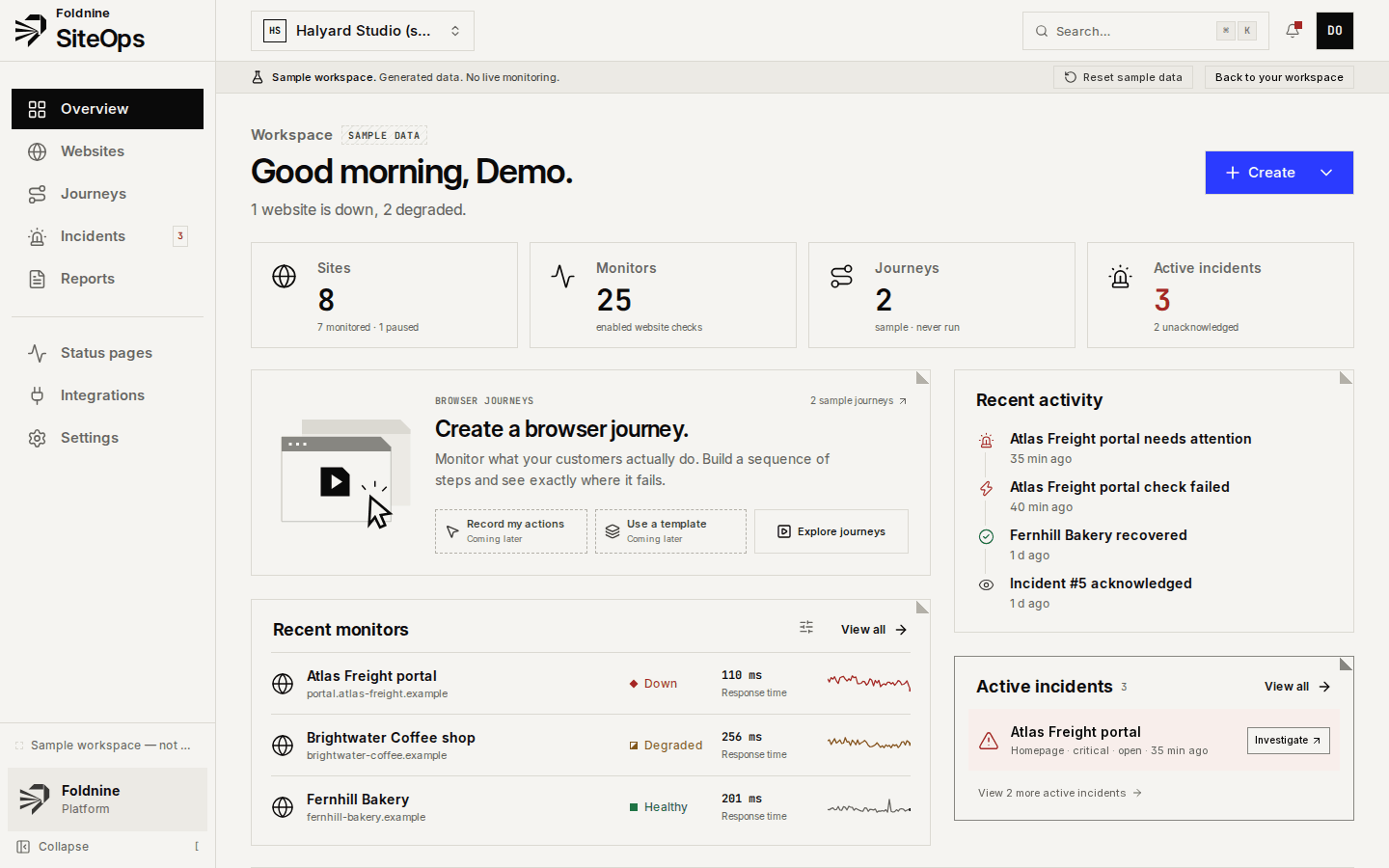
The short answer
Which one fits you
Choose Oh Dear if
- You need checks SiteOps does not run: mixed content, Lighthouse performance, cron, sitemap, port scans, domain expiry or DNS blocklists.
- You want checks from many locations, status pages on your own domain, or SSO.
- You want a mature product with a long track record.
Choose SiteOps if
- You look after 30 or 100 client sites and price matters: Studio is €29 a month for 30 sites, Agency €69 for 100.
- You want multi-step browser journeys, such as a login or a checkout, which Oh Dear does not run.
- You want a free plan to start with five sites, no card.
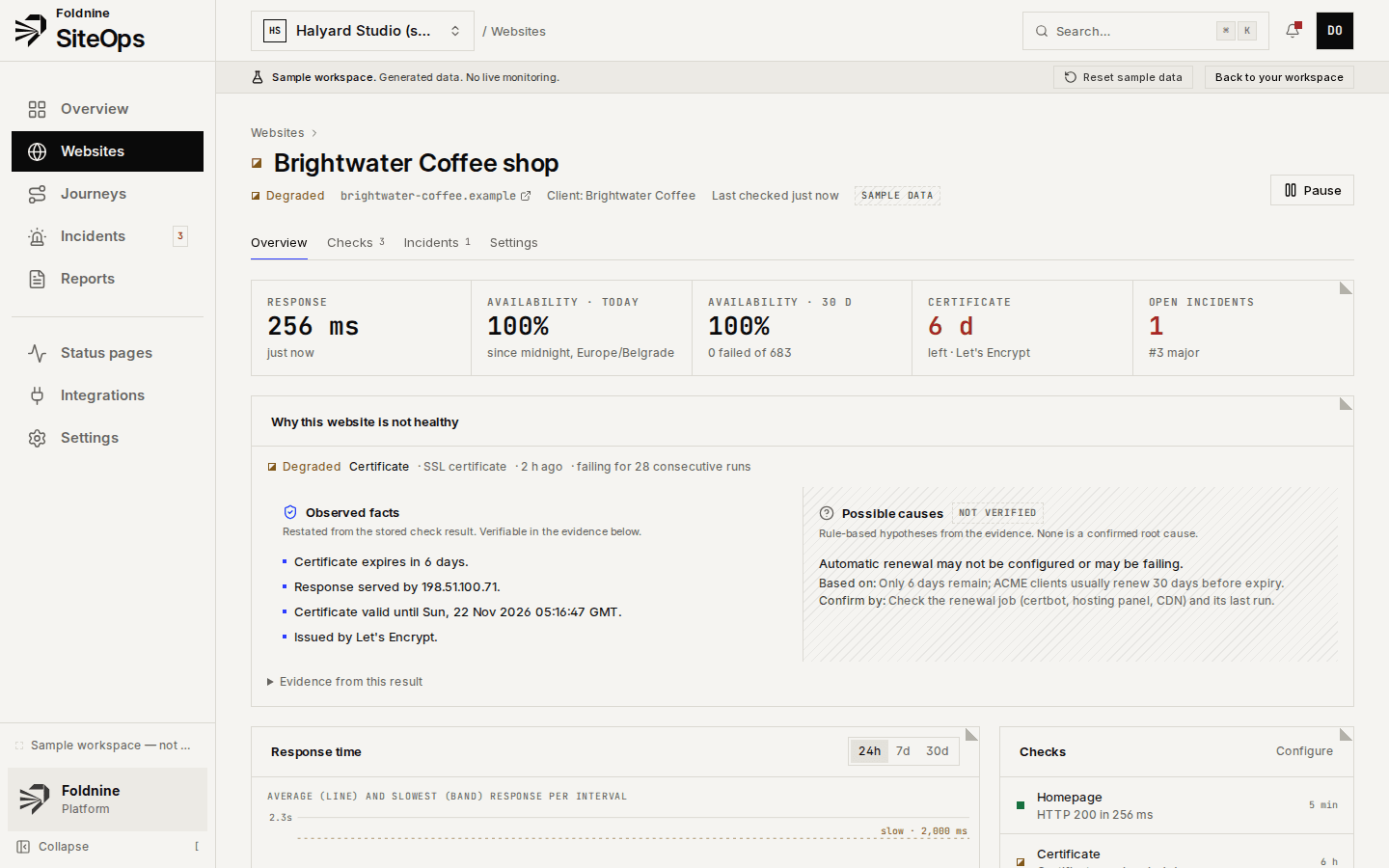
Side by side
SiteOps and Oh Dear, feature by feature
Oh Dear's plans and features as published on its own site, read on 26 October 2026; prices in its currency. Check the pricing, features and notifications pages before deciding; they change.
| Topic | SiteOps | Oh Dear | Ahead |
|---|---|---|---|
| Price | Free (5 sites); Studio €29/mo (30 sites); Agency €69/mo (100 sites). Priced per website, not per check | Solo $17/mo (2 sites), Freelance $55 (10), Studio $109 (25), Agency $165 (50), Portfolio $275 (100); excl. VAT; yearly = 2 months free | SiteOps |
| Free plan | 5 websites, checks every 5 minutes, email alerts, no card | No free plan; 10-day trial, no card | SiteOps |
| Fastest interval | 1 minute on Studio and Agency; 5 minutes on Free | 1 minute on every plan | Even |
| Check types | HTTP and response time, SSL certificate, DNS, read-only API (GET/HEAD with status and body assertions), broken links | Uptime, keyword, API (GET/POST/PUT/PATCH with JSON assertions), SSL, DNS, DNS blocklist, domain expiry, broken links, mixed content, Lighthouse, cron, sitemap, ports, application health | Oh Dear |
| Broken links | Same-site links on a page | Broken links and mixed content, site-wide | Oh Dear |
| Browser checks | Browser journeys (open, click, fill, assert, screenshot) on Agency, every 15 minutes at most | Not offered | SiteOps |
| Locations | One location (Germany); failures are re-checked from the Cloudflare edge before an incident opens. Not continuous multi-region | 33 checker servers in 16 cities; failures confirmed from a second city and provider | Oh Dear |
| Alerts | Email, Telegram, Slack and signed webhooks. No SMS or phone calls | Email, Slack, Teams, Discord, Google Chat, Telegram, SMS (your Vonage account), Pushover, ntfy, PagerDuty, Opsgenie, webhooks | Oh Dear |
| Status pages | Client status pages on Studio and up; white-label on Agency. Hosted on siteops.foldnine.dev, no custom domain yet | Branded status pages with your own domain and subscriber notifications, every plan | Oh Dear |
| Client reports | Monthly client report by email, per client, on the day you choose; white-label on Agency | Monthly email reports and branded client reports | Even |
| Incident detail | Incidents keep the evidence (status, headers, timings, certificate, DNS) and list facts apart from unverified causes; a read-only link you can send the client | Check results and history per site (we did not test its incident view) | Even |
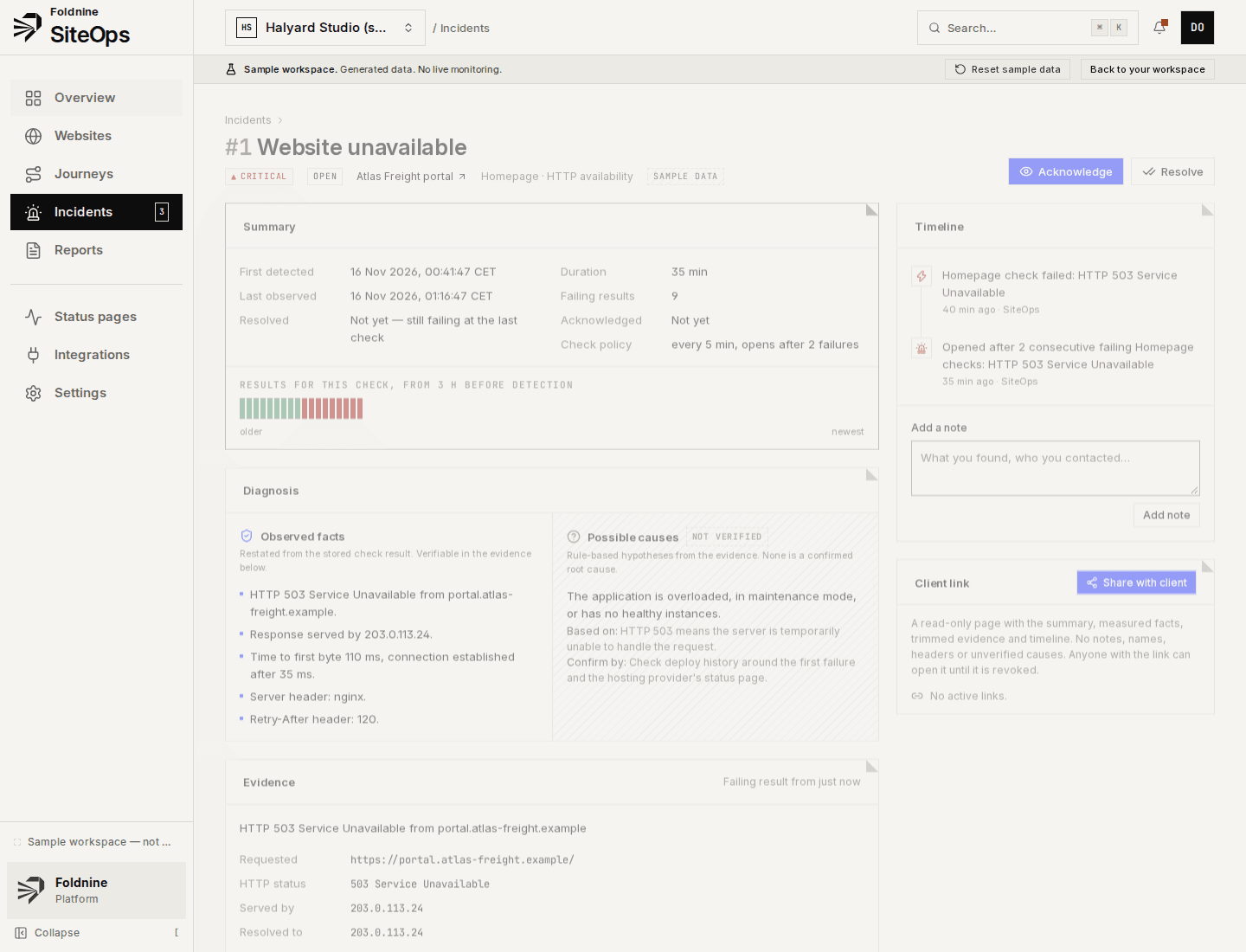
When something fails
An incident you can forward without rewriting.
01A check fails twice
One bad result is noise. Two consecutive failures of the same check open an incident — threshold adjustable per check.
02Evidence is kept
HTTP status, response headers, body excerpt, resolved and serving address, TLS certificate, and where the time went.
03Facts apart from guesses
What was measured is listed as fact. Likely causes are labelled as unverified, each with what it rests on and how to confirm it.
04Recovery closes it
The first passing result resolves the incident and records how long it lasted. Notes and acknowledgements stay on the timeline.
Said plainly
Where SiteOps is weaker than Oh Dear
Better to read it here than find out after you have moved your client sites.
- Oh Dear runs many more check types, including mixed content, Lighthouse, cron and domain expiry.
- Oh Dear checks from 16 cities; SiteOps has one home location plus a Cloudflare confirmation on failure.
- Status pages on your own domain, SSO and more alert channels are Oh Dear features SiteOps lacks.
- Our broken-link check reads the links on one page, not a whole-site crawl.
For agencies
Every client, one place to look.
01 / 03
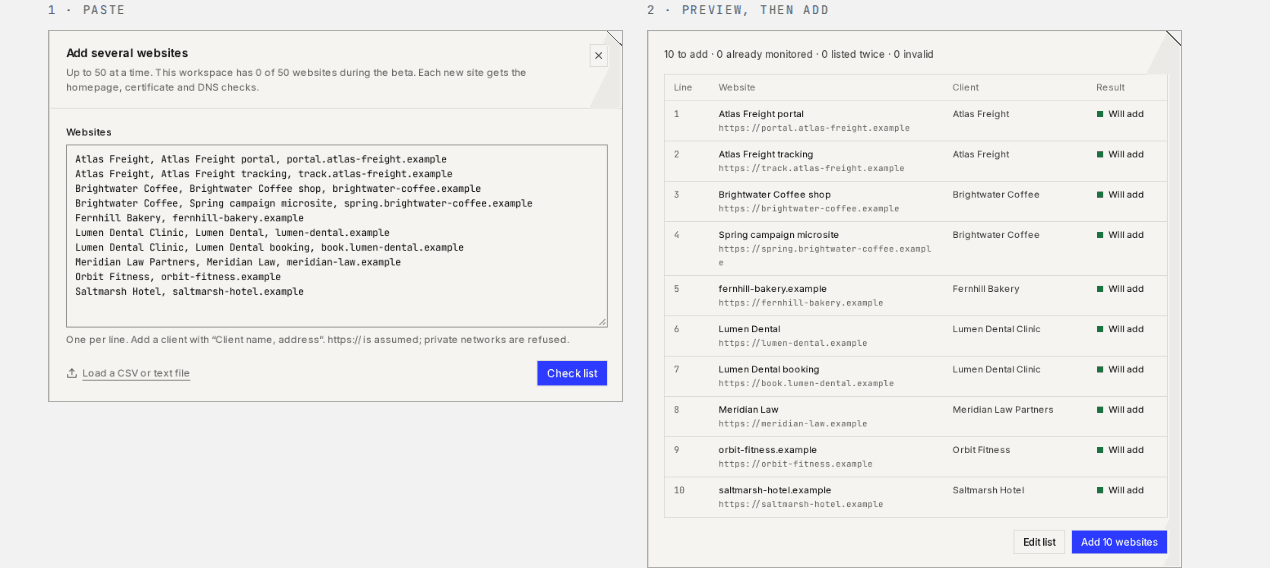
Add every client at once
Paste up to 50 addresses, or a CSV with client names. You see what will be added before anything is.
02 / 03
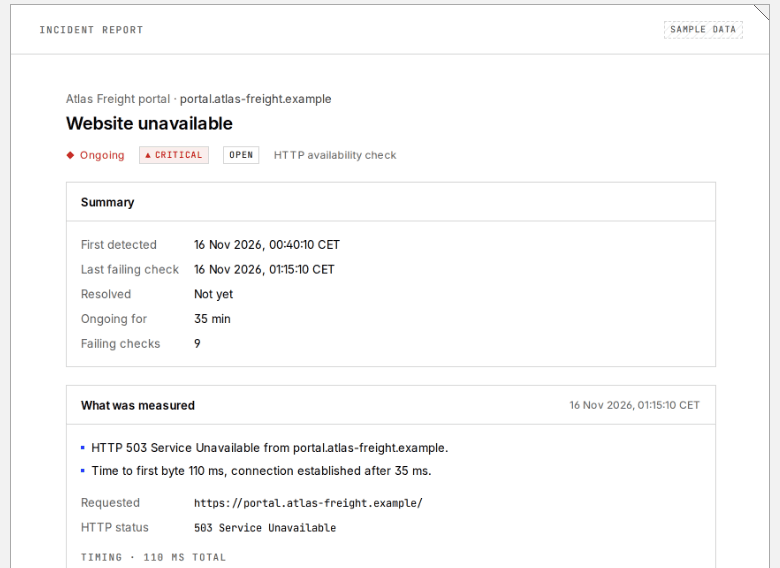
A link you can send the client
A read-only page for one incident: what was measured, when, and for how long. No internals, revocable at any time.
03 / 03
Monthly report, sent for you
Availability, response times, incidents and expiring certificates per client, emailed on the day you choose under your agency's name.
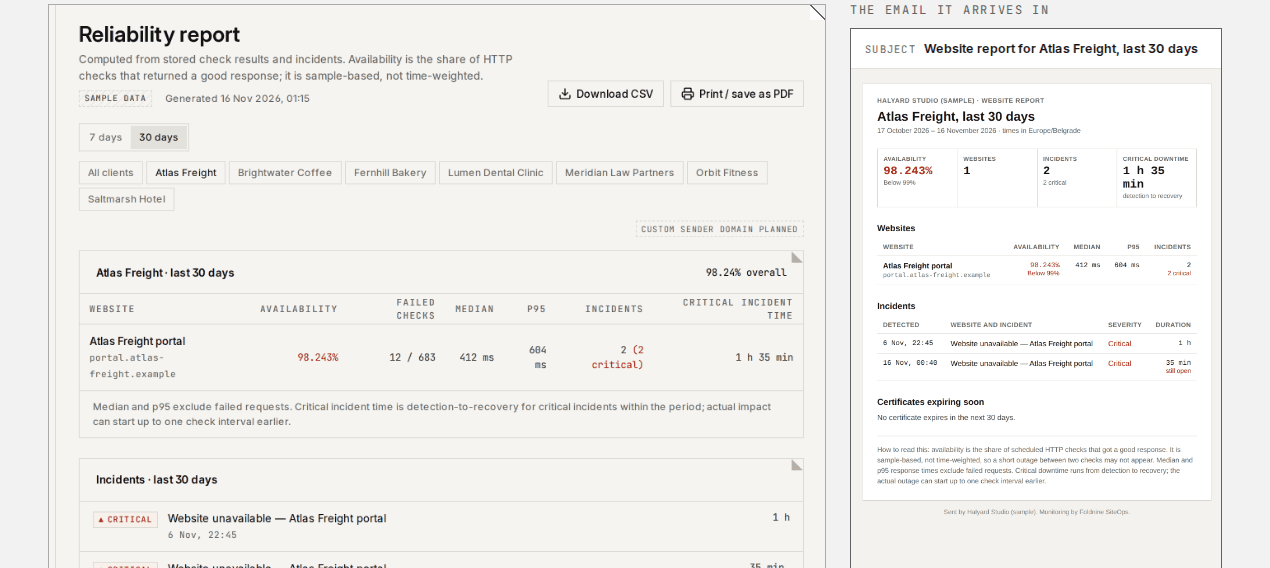
Screens from the built-in sample workspace: a fictional agency on reserved .example domains.
Questions
Frequently asked
- How much cheaper is SiteOps than Oh Dear?
- For 100 client sites Oh Dear lists Portfolio at $275 a month; SiteOps Agency is €69 a month for 100 sites. For 25 to 30 sites it is Oh Dear Studio at $109 against SiteOps Studio at €29. Oh Dear includes more check types and locations for that price.
- Does SiteOps check mixed content or Lighthouse scores?
- No. SiteOps checks availability and response time, SSL certificates, DNS, read-only API endpoints, broken links on a page, and browser journeys. If mixed content or performance scores matter to you, Oh Dear covers them.
- Can SiteOps status pages use my domain?
- Not yet. Status pages are served at siteops.foldnine.dev/status/your-name, and the Agency plan removes SiteOps branding in favour of yours. Oh Dear supports custom domains.
- Does SiteOps have browser or transaction checks?
- Yes, on the Agency plan: browser journeys with declarative steps (open, click, fill with test data, assert text or URL, screenshot), run in a fresh Chromium at most every 15 minutes.